)
)
)
Sormac investigates new solutions in the fight against aphids
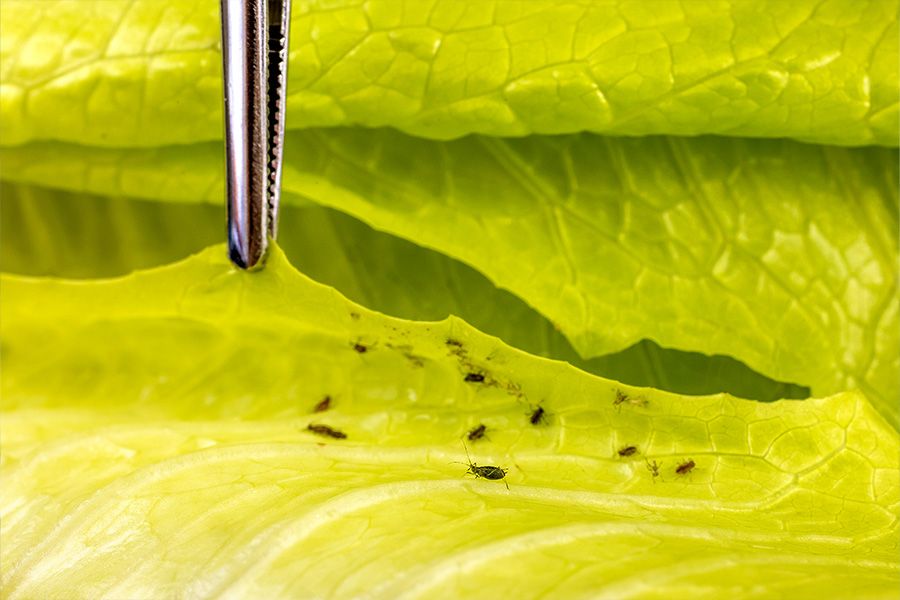
To ensure all research is reliable and reproducible, Sormac has developed a standardised counting method, which allows the presence of aphids to be measured objectively and comparably.
Ban on aphid control products
Within the European Union, plant protection products for aphid control have not been available since 30 October 2024, and their use will not be permitted from 30 October 2025. Their authorisation was withdrawn due to negative effects on beneficial insects and bees, threatening biodiversity and sustainability goals.
In the United Kingdom and other countries outside the EU, these products are still permitted for the time-being, but reassessments are underway in those countries too.
Why aphids are becoming a growing problem
As chemical control agents are phased out, aphids are increasingly being found during quality inspections, both on the produce and in the washing water.
Their rapid lifecycle makes aphids particularly difficult to control: within just seven days, an egg develops into a nymph which, at temperatures above 10°C, becomes an adult aphid in approximately seven to ten days. This can occur within the usual shelf-life period, even inside the packaging. Nymphs moult several times, leaving behind pale skins on the produce. Both adult aphids and nymphs have a piercing-sucking mouthpart (rostrum/stylet) which allows them to feed on plant sap. They use this mouthpart to latch onto the crop, making removal difficult.
Standardised counting method for objective measurement
The changing situation calls for a universal counting method that makes the effect of processing steps reliable and reproducible. Sormac has developed a standardised guideline for this purpose.
With this method, the presence of aphids is expressed as the number of aphids per 100 grams of produce, measured on full lettuce heads. To obtain a representative picture of reduction throughout the process, samples are taken at the start, middle, and end of each production run.
)
)
)
)
)
)
)
)
)
)
)
)
)
)
)
)
)
)
)
)
)
)
)
)
)