

The food and drink industry is changing fast. But which shifts will actually matter?

From the rise of AI-powered product discovery and changing consumer eating habits to regenerative agriculture, food waste and supply chain challenges, the food & drink industry is facing a wave of change.

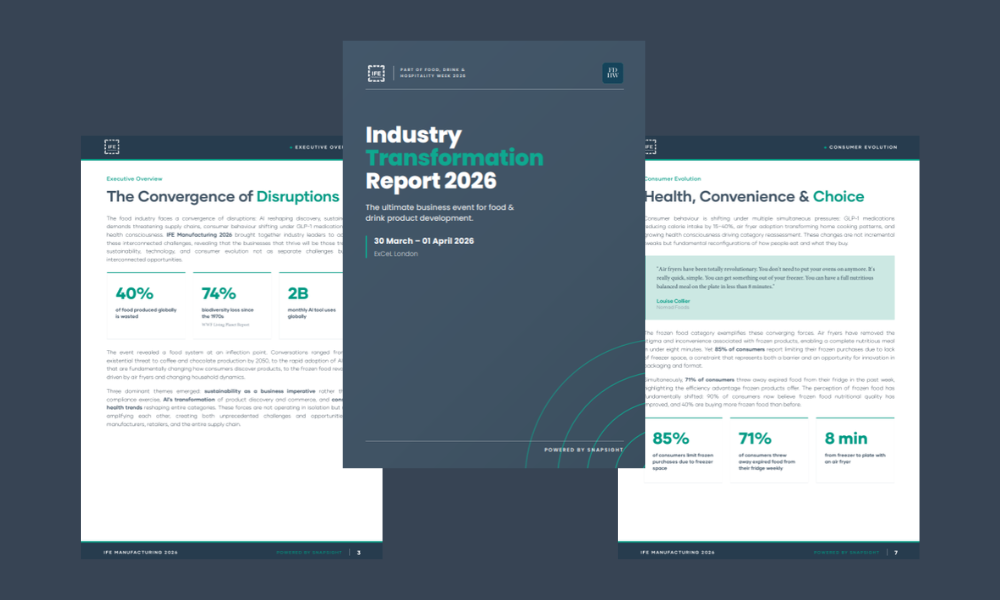
Drawing on key discussions from IFE Manufacturing 2026, The Food Industry at a Crossroads report explores how these interconnected trends are reshaping the industry, uncovering the challenges, opportunities and strategic decisions facing food & drink businesses.



 

What trends are shaping the future of food & drink manufacturing? 

Consumer health trends are pushing food manufacturers to rethink product formulation, portion sizes and nutritional positioning. The IFE Manufacturing Industry Transformation Report 2026 highlights how GLP-1 medications, associated with a 15-40% reduction in calorie intake, are changing eating habits alongside growing health consciousness and demand for convenience. 

For NPD and R&D teams, these shifts raise important questions about how existing products should evolve and where new opportunities may emerge. From nutrition-focused innovation to new product formats, manufacturers must increasingly consider how changing consumption patterns could affect future category demand. 

The report explores how these developments are influencing food innovation and the strategic decisions facing manufacturers. 

Reducing food waste can create opportunities for manufacturers to recover value from materials that would otherwise be discarded. The IFE Manufacturing report highlights that seven times more food waste occurs in manufacturing than in retail, identifying potential for R&D, resource recovery and new revenue streams. 

Rather than viewing waste solely as an environmental or disposal challenge, manufacturers can investigate how production losses and unused materials might contribute to more efficient processes or new commercial applications. 

The report positions waste reduction as part of a wider shift towards sustainability that delivers business value, raising questions about how manufacturers can balance environmental improvements with commercial performance.

Convenience is changing expectations around food preparation, product formats and packaging. According to the IFE Manufacturing report, air fryer adoption is helping transform the frozen food category, with some products enabling consumers to prepare complete meals in under eight minutes. 

However, the report also identifies a significant constraint: 85% of consumers limit frozen purchases because of insufficient freezer space. This presents a product development challenge for manufacturers looking to balance convenience, storage requirements and consumer demand. 

For NPD and packaging teams, changing household habits could create opportunities to rethink product sizes, packaging formats and preparation methods. The report explores how these shifts are reshaping established food categories.

Regenerative agriculture is becoming increasingly relevant to food manufacturers seeking to strengthen the long-term resilience of their ingredient supply chains. The IFE Manufacturing report highlights how soil health, biodiversity and production practices are becoming central to sustainability strategies. 

The report also challenges the assumption that locally produced food is automatically more sustainable, arguing that production methods must be considered alongside geographical origin. 

For manufacturers, this creates important sourcing questions around ingredient availability, environmental impact and long-term production capacity. It also raises an ongoing industry debate about the relationship between organic certification and regenerative approaches focused on measurable outcomes. 

Building supply-chain resilience requires manufacturers to look beyond immediate sourcing costs and consider the long-term availability, sustainability and traceability of ingredients. 

The IFE Manufacturing report highlights growing pressure from biodiversity loss, dependence on global supply chains and the risks associated with unsustainable production practices. It recommends diversifying crop dependencies, improving supply-chain transparency and investing in production methods that support long-term resilience. 

For food manufacturers, the challenge is balancing commercial viability with the need to protect future ingredient supplies. The report examines the unresolved tensions between local sourcing and global supply chains, alongside the strategic decisions businesses face as sustainability becomes increasingly important to production continuity.

AI is changing how food & drink products are discovered and recommended, creating new commercial considerations for manufacturers and brand owners. 

The IFE Manufacturing report highlights the rapid adoption of AI tools and their growing influence over product discovery. It describes how AI-generated recommendations can narrow the number of businesses presented to consumers, making digital visibility increasingly important. 

For manufacturers developing new products, innovation does not end when a product reaches the market. Businesses also need to consider how buyers and consumers discover their products and evaluate alternatives. 

The report explores AI-driven discovery as part of the wider technological disruption affecting food businesses. 

Changing consumer expectations around health and sustainability are creating opportunities for food manufacturers to reconsider established protein categories. 

The IFE Manufacturing report highlights the ambition to double UK bean consumption by 2028, noting that two-thirds of the population currently eat less than one portion of beans per week. This indicates an opportunity to increase consumption of an existing plant-based protein source. 

The report also describes how product positioning, consumer education and retail placement can influence demand. For manufacturers, the findings suggest that opportunities may come not only from developing new products, but also from helping consumers discover new uses for familiar ingredients.

Food manufacturers face increasing pressure to improve environmental performance while maintaining commercially viable operations. 

The IFE Manufacturing report argues that sustainability needs to move beyond compliance and become a source of business value. Opportunities discussed include reducing production waste, recovering resources and investing in agricultural practices that support long-term ingredient availability. 

However, the report also acknowledges an unresolved challenge: the return on sustainability investment may not always be immediate or easy to quantify. 

Manufacturers must therefore balance short-term profitability with longer-term risks to production and supply chains. The report explores why sustainability is increasingly being treated as a business-continuity issue rather than a standalone environmental initiative. 

Food product innovation is not limited to developing entirely new products. Changes in positioning, merchandising and consumer education can also create demand within established categories. 

The IFE Manufacturing report highlights Bold Bean Company's experience of placing beans within the meat, fish and poultry section rather than the traditional canned goods aisle. According to the report, 70% of the resulting sales were incremental to the category. 

This suggests that how consumers encounter and understand products can influence category growth. For manufacturers and NPD teams, it raises opportunities to rethink product applications, positioning and communication alongside formulation and development. 

The report explores how challenging traditional category boundaries can open new commercial opportunities.

Food and drink manufacturers are facing interconnected challenges involving sustainability, changing consumer behaviour, supply-chain resilience and technological disruption. 

The IFE Manufacturing report identifies three major forces shaping the industry: sustainability becoming a commercial necessity, AI changing how products are discovered, and health trends influencing consumption patterns. 

These developments are creating new pressures around ingredient sourcing, production efficiency, product innovation and commercial competitiveness. 

Rather than addressing each challenge independently, the report argues that manufacturers need to consider how these forces interact. Its strategic recommendations cover sustainability, technology, consumer evolution, supply-chain resilience and innovation opportunities that could influence future manufacturing decisions.